Lytic and Lysogenic Cycle
Bacteriophages like T2, T4, etc. possess two types of life cycles namely lytic and lysogenic.
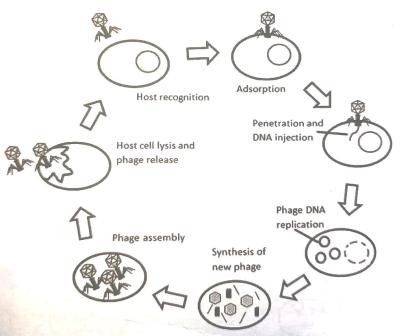
Lytic cycle:
It consists of the following steps-
Adsorption: Phage particles get attached to the bacterial cell wall with the help of its pointed pegs.
Penetration: After attachment, they secrete an enzyme lysozyme which is responsible for the partial degradation of the bacterial cell wall to create a pore or hole in the bacterial cell wall through which phage particles inject their DNA into the bacterial cell. At that time the tail of the bacteriophage acts as a micro-syringe.
Synthesis: This step consists of two phases-
a) Degradation of bacterial DNA or nucleoid to arrest the metabolic activity of bacteria and hijack the bacterial cell by the viral genome. And
b) Synthesis of viral protein.
Replication: Viral DNA undergoes replication to produce a large number of viral DNA Assembly: Viral protein and viral DNA get assembled to form new phage particles.
Lysis and Release: After the maturation of new progeny the host cell undergo lysis and releases the phages of new progeny. After liberation, they start to attack new bacterial cells if available. On the unavailability of fresh bacterial cells, they behave as virions; viral particles having the ability of infection.
The time interval between viral infection and the appearance of the first intracellular virus particle is called the eclipse period and the time taken between viral infection and the first release of viral progeny is called latent period. Bacteriophage required 15-30 minutes to complete the cycle.
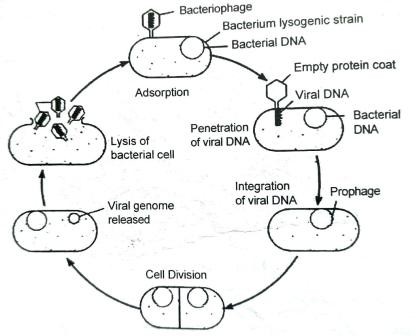
Lysogenic cycle:
It is a temperate or non-virulent form of the life cycle. In this type of replication viral DNA instead of degrading bacterial DNA gets integrated with later to form prophage. The virus does not cause immediate lysis of bacterial cells and does not produce progeny immediately. The cycle consists of the following phases
Adsorption: Phage particles get attached to the bacterial cell wall with the help of its pointed pegs.
Penetration: After attachment, they secrete an enzyme lysozyme which is responsible for the partial degradation of the bacterial cell wall to create a pore or hole in the bacterial cell wall through which phage particles inject their DNA into the bacterial cell. At that time the tail of the bacteriophage acts as a micro-syringe.
Formation of Prophage: Unlike the lytic cycle viral genome does not degrade the bacterial nucleoid. The viral genome produces a repressor, which does not allow the viral genome to hijack the metabolic machinery of the host bacterial cell. The viral genome also secretes an enzyme integrase with the help of which viral DNA gets attached to the bacterial DNA to form a recombinant DNA called prophage or provirus. The viral particle remains nonvirulent therefore this phase is also called the temperate phase.
Lysogeny: The prophage multiplies along with the multiplication of host bacterial cells by binary fission. The condition of the host cell carrying the prophage is called lysogeny.
Induction: Suddenly the repressor code of the viral genome withdraws spontaneously or due to the action of certain physical and chemical factors. As a result which viral genome gets separated from the bacterial genome and becomes virulent.
After separation they perform the steps synthesis, replication, assembly, lysis and release like Lytic cycle.