
Immunity
Every day we are exposed to large number of infectious agents. However, only a few of these exposures result in disease. Why? This is due to the fact that the body is able to defend itself from most of these foreign agents. This overall ability of the host to fight the disease-causing organisms, conferred by the immune system is called immunity.
Immunity is of two types:
- Innate immunity
- Acquired immunity
INNATE IMMUNITY
Innate immunity is non-specific type of deface, that is present at the time of birth. This is accomplished by providing different types of barriers to the entry of the foregin agents into our body. Innate immunity consist of four types of barries. These are
1. Physical /Anatomical Barrier: It is made up of two parts
Skin: Skin on our body is the main barrier which prevents entry of the micro-organisms. Outermost layer of skin is dead, so the bacteria do not grow or enter into it. pH of skin (3 to 5) destroy the bacteria. Mucosa: Mucus coating of epithelium lining of the respiratory, gastrointestinal and urogenital tracts also help in trapping microbes entering our body. Mucosa contain_mucosal cells and cilia. Mucosa entraps the micro-organism and cilia propel the microbes.
2. Physiological Barriers : Some physiological processes of body create adverse environment for growth of bacteria. Acid in the stomach, saliva in the mouth, tears from eyes-all prevent microbial growth.
Fever: High temperature of body, inhibit the growth of microbes.
pH of body : Acidic pH of various part of body like oral cavity, stomach and vagina inhibit the growth of microbes.
Secretions: Secretions of body like eyes, sebum contain lysozyme, this enzyme destroys the microbes
3. Cellular Barrier Polymorpho-nuclear leukocytes (PMNL-neutrophils), monocytes and natural killer cells (type of lymphocytes) in the blood as well as macrophages in tissues can phagocytose and destroy microbes.
(A) Phagocytic Cells –(e.g. Monocytes, PMNL-neutrophil. Macrophage). In response to pathogenic infection, the total count of WBC in body increases. Phagocytosis is exhibited by some types of WBCs Such WBCs are called phagocytes.
Most important phagocytes are macrophages and neutrophils. Monocytes are liberated at the site of infection these later converted into macrophages.
Macrophages are large irregular shaped cells that engulf microbes, virus, cellular debris etc. in response to an infection.
(B) Non-Phagocytic cells: (Eg: Natural Killer Cell It is a large granular lymphocyte cell. During this process apart from the phagocytes, another type of cells called Natural killer cells kill virus infected cells and tumour cells of body by creating perforin lined pores in the plasma membrane of target cells (i.e. infected cells). Water enters through these pores causing swelling and bursting of the diseased cells.
Cytokine Barriers: Virus-infected cells secrete proteins called interferons which protect non-infected cells from further viral infection.
Interferon are anti-viral protein made up to 270 amino acids secreated by virus infected cells and stimulates the adjacent cells to produce the Translation Inhibiting Protein (T.I.P)
By this mechanism interferon limits the infection of virus.
Interferon are species specific .e. interferons produced by one species can protect only cells of same species against viral infection.
Interferon make cells resistant to viral infection by synthesis of antiviral proteins in that cell.
Interferons can be used for prophylaxis and treatment of viral infections.
INFs -a = activate immune system and destroy tumor. It has shown some success in causing of regression of Kaposi sarcoma in AIDS patients.
Inflammation: Local response of living mammalian tissue to injury due to any agent. It is the body defence reaction in order to eliminate or limit the spread of infectious agent.
Inflammation is characterised by –
Redness (Rubor/Erythema) – due to vasodilation.
Heat (Calor) – metabolic reactions proceed more rapidly.
Swelling (Tumor) -due to increased permeability of blood vessels.
Pain (Dolor) – results from injury to neurons and chemicals released by damaged cells (eg. prostaglandins).
ACQUIRED IMMUNITY:
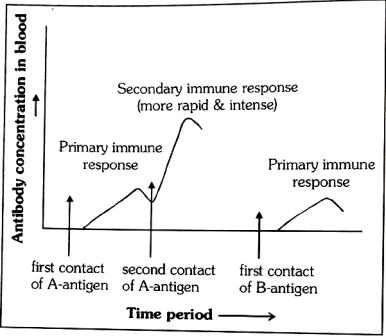
Acquired immunity, on the other hand, is pathogen specific. It is characterised by memory. This means that our body when it encounters a pathogen for the first time produces a response called primary response which is of low intensity. Subsequent encounter with the same pathogen elicits a highly intensified secondary or anamnestic response. This is ascribed to the fact that our body appears to have memory of the first encounter.
Features of Acquired immunity :
Specificity : Acquired immunity is specific for specific micro-organisms.
Diversity: This system recognise the vast variety of micro-organisms.
Discrimination between self and non-self. It can recognise self (body or tissue) and non self ( foreign tissue) and respond according to them.
Memory: When a pathogen enter inside the body, body takes longer times to recognise and respond to it this is called primary immune response but the memory of this encounter remain in immune system.
When similar pathogen enters second time inside the body, body immune system rapidly recognises the pathogen and responds quickly to it. This is called secondary (Anamnestic) immune response. This is based on memory of immune system.
The primary and secondary immune responses are carried out with the help of two special types of lymphocytes present in our blood, i.e., B-lymphocytes and T-lymphocytes. The B-lymphocytes produce an army of proteins in response to pathogens into our blood to fight with them. These proteins are called antibodies. The T-cells themselves do not secrete antibodies but help B cells, to produce them.
ACTIVE AND PASSIVE IMMUNITY:
When a host is exposed to antigens, which may be in the form of living or dead microbes or other proteins. antibodies are produced in the host body. This type of immunity is called active immunity. Active immunity is slow and takes time to give its full effective response. Injecting the microbes deliberately during immunisation or infectious organisms gaining access into body during natural infection induce active immunity.
When ready-made antibodies are directly given to protect the body against foreign agents, it is called passive immunity.
Do you know why mother’s milk is considered very essential for the newborn infant? The yellowish fluid colosstrum secreted by mother during the initial days of lactation has abundant antibodies (lg A) to protect the intant.
The foetus also receives some antibodies from their mother, through the placenta during pregnancy. These are some examples of passive immunity.