
Gamma irradiation
The garden in which crop plants are irradiated with gamma rays for mutation breeding, is called gamma garden. In India, the first gamma garden was established in 1959 at the Bose Research Institute, Kolkata and the second one was established at the Indian Agricultural Research Institute, New Delhi, in 1960. Several improved crop varieties have been developed in these gardens and released for cultivation in India.
The gamma garden of the IARI has an area of three acres. This area is encircled with a brick wall of 3 feet thick and 12 feet height, which acts as a protective shielding to the garden. Barbered wire fence is erected around the wall to prevent the entry of unauthorized persons into the gamma garden.
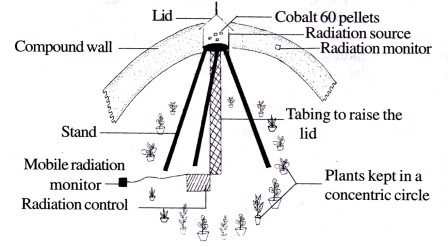
A radioactive cobalt source is erected in the center of the garden. It is a small container made up of lead and a lid on the top. The lid can go up and down through a rod inside the aluminum tube fitted with the container. It can be lifted from the container by switching a button in the operation room outside the garden. Small pellets of CO⁶⁰ weighing six grams are kept inside the container so that they can emit 200 curies of gamma rays per second. The container is fixed at a height of 20 feet height from the ground level.
The lead container along with cobalt-60 is purchased from the Department of Atomic Energy of Canada and fixed in the gamma garden.
Plants in pots are kept around the radioactive cobalt source in concentric circles. The whole garden is divided into eight sectors. Each sector is allotted for a specific type of plants. Cereals are kept in one sector, pulses are kept in another sector, and vegetables are kept in yet other sector and so on. The plants are watered properly through suitable pipe connections.
There are two radiation monitors in the gamma garden. One radiation monitor is stably fixed to the inner side of the compound wall. The other one is a mobile radiation monitor which can be carried radially around the source to detect the exact intensity of ƴ – radiation at any particular site.
When the lid is lifted by operating the button, the whole garden receives gamma radiations. Plants kept near the radiation Source receive the highest dose of radiation and those kept far away from the source receive much low dose of radiation. Therefore, mutagenic effect of gamma radiation is high near the radiation source.
This gamma garden is now under the administrative control of the Head of Botany Division, IARI. It has the following facilities:
Any researcher at regional agricultural stations and universities can make use of the gamma garden for their works on radiation genetics and Plant breeding.
Anyone interested in radiation biology can get irradiated seeds, seedlings and others from the gamma garden.
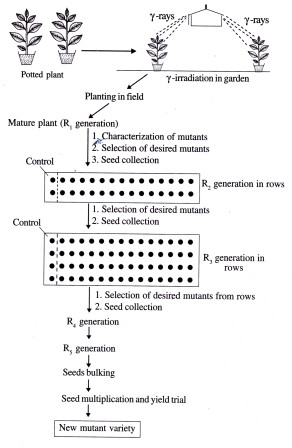
Production of new improved crop varieties bf irradiating the plant materials with X-rays or ƴ -rays is called irradiation breeding. It involves the following main steps:
- Selection of Plant materials.
- Radiation treatment
- Raising the first irradiation generation
- Study of effects of irradiation
- Raising of second irradiation generation
- Raising of R₃-R₅ generations
- Yield trials
- Release of a variety
1. Selection of Plant Materials:
Plant materials such as seeds, seedlings and cuttings can be used as the sources for irradiation. However, the right specimen to be chosen for irradiation varies from species to species and the dose of the irradiation.
In general, plants with large chromosomes are more susceptible to mutation than those with small chromosomes. Polyploids of a species are more resistant to irradiation mutation than the diploid individuals. Besides this, the hybrids are more resistant than the parents. Therefore, the genetic constitution and radio sensitivity of the plant materials have to be known prior to start irradiation breeding.
Fresh air-dried seeds are comparatively more resistant to irradiation breeding than aged and soaked seeds. Therefore, seeds containing normal water content are chosen for irradiation. Stocked seeds and young seeds should not be used for the irradiation.
Mature plants are usually more resistant to irradiation than the seedlings. If mutations have to be introduced in gametes, plants at flowering stage are chosen for irradiation. Otherwise, seedlings, which are neither too young nor too old, are ideal for inducing irradiation mutations. They are very convenient for handling in pots and easy transportation.
In the case of vegetative propagating plants’ cuttings newly established in pots are best for inducing mutations. For plants reproducing through suckers, corms, tubers and bulbs, the prop gules are directly exposed to radiations.
2. Radiation Treatment:
The selected plant material may be irradiated with X-rays, Y-rays, neutron or B-rays for inducing mutations.
X-ray irradiation is given inside the X-ray room. The plant materials (seeds in Petri dishes or seedlings in pots) are carried to the room and kept before the X-ray machine. The X-ray machine is adjusted so as to emit the required dose of X-rays for a few minutes. X-ray treatment can be given only to a small number of plants at a time.
Gamma ray irradiation is given in the gamma garden. Potted plants are carried to the gamma garden and kept around the radioactive source. The lid of the container is lifted to enable the source to emit y-rays. After getting enough exposure, the potted plants are taken away. For seed treatment, the Petri dishes containing the seeds are kept in the aluminum tray fixed with the lead container. After giving enough radiation, the seeds are taken for further Studies.
For giving neutron treatment, the seeds or seedlings are exposed to the neutron flush coming from the generator. The neutron generators are installed in the Department of Atomic Energy at different regions of India.
Beta rays’ treatment is given in the Radioisotope Laboratories. Aqueous solutions of radioactive isotopes (P³² or S³⁵) are prepared and the seeds or seedlings are kept immersed in the solution for a specific duration.
The amount of radiation supplied to the plant material should be less than its LD50. This LD50 is the amount of radiation required to kill 50% of the individuals. The proper dose will produce the maximum number of beneficial mutations and least number of undesirable mutations. It varies with species and nature of plant materials. Therefore, the required proper dose has to be detected before starting the radiation works.
3. Raising of the First Irradiation Generation:
The plants raised from the irradiated seeds or seedlings are called first irradiation generation (R₁). R₁ is raised immediately after the irradiation treatment because prolonged storage may produce radiation injury in R₁ generation. A proper control is maintained for easy comparison of mutagenic effects in the R1 progeny.
4. Study of Effects of Irradiation:
Among the irradiated plants only a few have shown the mutation effects because natural plant materials have stabilized genetic system which responds much less to artificial mutations.
Even in the mutants, the mutation effect may be due to chromosomal aberrations or cytoplasmic changes or gene mutations. Mutation effects due to chromosomal aberrations and cytoplasmic changes are of no use in plant breeding because they may be reverted very soon. Mutation effects appeared due to gene mutations are useful for crop improvement.
The R1 mutant individuals show four types of mutation effects:
- Death of individuals due to radiation injury.
- Growth inhibition due to metabolic changes’
- Morphological and genetic abnormalities due to chromosomal aberrations and cytoplasmic changes.
- Genetic changes due to point mutations. This is very useful for crop improvement.
Gene mutants may differ from the control in morphology, height, growth, anatomy, physiology and biochemistry. All these properties should therefore be studied carefully with the control and mutant individuals. The data is recorded properly”
5. Raising of Second Irradiation Generation:
Plants with desired property is selected from the R₁ individuals to collect seeds to raise the second irradiation generation (R₂). While selecting desired mutants, importance is given for the following properties:
- Fast growth
- Dwarfness
- More tillering
- Resistant to lodging
- Resistance to diseases
- Resistance to pests
- High yield
- More number of grains
- Tallness of plants
- Good grain quality, etc.
Seeds of desired mutants are collected separately and sown in separate rows to raise R₂ crops in an isolated plot. Thus, 10-15 plants are raised in a row. Each row should have one or two control plants for the comparison of mutation.
6. Raising of R3-R5 Generations:
Individuals having desired traits are selected from each and every row of R₂ generation and then seeds are collected separately. 10-15 seeds collected from a mutant are sown in a row. Thus, seeds of selected plants are sown in separate rows to raise R₃ generation.
In this way, seeds are collected from desired mutants in each and every row bf R₃ generation and R₄ generation is raised. From the R₄ seeds, R₅ generation is raised.
7. Yield Trials:
Seeds are harvested from the desired mutants from the R5 generation and bulked together. These seeds are sown in an isolate plot to raise the subsequent crop for yield trials. The yield is compared with the yield of the parent variety to detect the suitability of the new variety for release to farmers.
If the mutant gives lower yield than the parent, it is once again manipulated by performing hybridization with a suitable parent line to increase the yield. Then it is released as a new variety.
8. Release of a Variety:
Seeds of the desired mutant are bulked by sowing them in an isolated plot. The plants are thoroughly characterized, named and released as a new improved variety.