
Action research stages
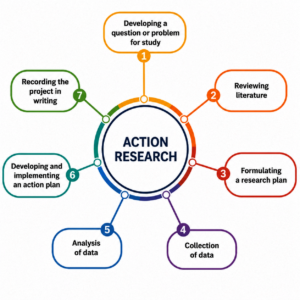
The steps for conducting action research are not much different from those followed with any other type of research. The recursive or the cyclic process of action research starts with the identification of a problem and advances through developing a research statement and sometimes a hypothesis, collecting, analysing and interpreting data, taking action, reflecting and using the findings to bring changes in practice. However, the steps for conducting action research involve the step of preparing an action plan in addition to the steps followed in other types of research. It is also important to note here that, literature in the field of action research suggests that the detailed steps in action research are deliberately unspecific so that a variety of issues and questions that arise in complex educational settings may be accommodated. After making detailed analysis and synthesis of the models of action research developed by experts and literature on the subject, the following steps can be suggested for conducting action research in education:
- Developing a question or problem for study
- Reviewing literature
- Formulating a research plan
- Collection of data
- Analysis of data
- Developing and implementing an action plan
- Recording the project in writing
Developing a question or problem for study:
The first important step for conducting action research is to identify a problem that is faced by the teacher or the practitioner and translate the problem into a research question.
Action research starts with a practical problem and with serious reflection directed toward the solution of the problem. The problem selected may be a classroom problem faced by the teacher or a problem faced by the community or organization.
After engaging in deep reflection on the problem or issue, the action researcher needs to write down or phrase the problem as a question to be answered. Thus, identifying and developing a problem or question is the first step in the action research process. It is noteworthy that the question developed for guiding the research must be a question of higher order rather than a simple “yes/no” type of question. Moreover, the question should be simple, researchable and phrased in simple and straightforward language avoiding jargon. It must also be seen that the question selected does not already have an answer.
Some examples of questions for action research may be like the following:
Why do my students lack motivation to read?
Reviewing literature:
Reviewing literature related to one’s topic of research is an important part of conducting all forms of research. Be it a local and small action research project or a fundamental research project, the researcher needs to read about his or her topic in order to place the topic in a particular context within existing literature. However, in case of action research a smaller and more relevant range of literature survey is an important necessity. In order to understand, locate, plan and evaluate a study more effectively the action researcher needs to review literature in the field of his or study. Review of related literature helps the researcher in understanding the issues-related to the topic of research. It can also help in developing and refining the research topic or question selected for conducting action research. Moreover, it can help in identifying what has already been done in the field and what needs to be done. It also helps to be informed about the research methods used by other researchers in the field and also to evaluate their findings.
Formulating a research plan:
A good action research project needs careful planning on the part of the researcher. Although action research does not necessarily progress in a linear mode or go through a predetermined set of steps, it is important that the researcher is cognizant of the progression through the different activities involved in the process.
After identification of topic or question for research and making a survey of related literature, the task of formulating an action plan to guide the process of research has to be done. This is the stage of making a plan for actually conducting the investigation. The action plan may be an informal outline of the steps to be followed or it may at times include a specific timeline for the different steps in the process.
Collection of data:
After formulating the action plan, the next important task for the researcher is to collect relevant data. At this point the researcher has to decide the methods for collecting and organizing data needed for the study. Collection of data should always be based on: an analysis of the various methods of data collection; their relative merits and demerits; nature of the data required (i.e. qualitative, quantitative, or both); the time plan and time available for carrying out the research; as well as a consideration as to how the data collected will be interpreted. Moreover, the researcher has to consider ethical issues related to data-collection besides obtaining permission for collecting data from all concerned. The researcher also has to ensure that he has checked all the necessary tools and equipment required before collecting data and the data collected are relevant, valid and complete in all respect. He also needs to decide how or where the data will be stored and what methods will be used to analyse and interpret data. The researcher has to record the collected data and organize them in proper format for making appropriate analyses of data at a later stage.
Analysis of data:
Analysis of data is a crucial stage of any research activity. This is the stage of making final analysis and representing data before drawing conclusions and taking proper action. However, since action research progress through cycles of planning, data collecting, evaluating, and taking action, it requires continuous analyses of data. The continuous analyses of data in action research can help in building a coherent picture of the problem or issue at hand.
At the beginning of data analysis, the action researcher has to revisit the aims and expectations of the project. He needs to think about the questions for the study so as to constantly remind himself about what is being investigated. The collected data needs to be viewed from different angles so as to relate them to the original and expected outcomes of the project. However, the researcher must also be aware that the collected data may bring some unexpected outcomes as well, which may be of significance for the problem under investigation. However, the conclusions must relate to the original aims and objectives of the project.
Developing and implementing an action plan:
Developing and implementing an action plan is a unique feature of action research which is an important component of action research design. This step involves developing an immediate action plan for the implementation of the findings of the ongoing study. The plan could be an informal account portraying the implementation of a hew finding or an educational practice. It could also be a plan to discuss different ways of addressing the problem under study. The action plan may be a detailed and formal account or it may well be an informal outline of proposed activities or intervention. This action plan works as a strategy for trying out the ideas or the findings arrived at for the solution of the initial problem.
After developing and detailing the action plan, the next important thing is to implement the plan to see if the potential solution arrived at through the process of research could really solve the problem under study. In this step the potential solution to the problem is applied and the results are observed. In order to find out if the intervention could make a difference in the situation, the action researcher has to refer to the initial research question with which the study was started. Sometimes, when the solutions arrived at through the action research project fail to actually solve the problem under study, the action researcher needs to try other ideas and see if that could make any difference. Thus, the action research process moves in a cyclic nature of steps or activities and one research often leads to another research project.
Recording the project in writing:
Action research, like any other research, must be recorded in a logical and orderly manner so that the benefits of research could be shared among fellow practitioners, teachers. administrators and other stakeholders. The report of the action research project must be objective, vivid and straightforward so that the reader is able to gain maximum understanding about the project in minimum time and effort. The purpose of action research is to improve practice or to implement change in a situation that needs improvement. Hence the aim of action research is not to make generalizations, but to report and share an issue with other practitioners who are interested or who wants to learn from the report or wants to apply the findings to their situations.