
hybridization technique:
The technical operation of hybridization work is known as hybridization technique, which needs skilled persons. The hybridization technique involves the following steps:
- Selection of parents
- Emasculation
- Bagging
- Crossing
- Labeling
- Harvesting of hybrid seeds
- Raising F1 generation
1. Selection of Parents
This is the first step of the hybridization experiment. The parent plants are selected from the population of individuals growing in isolated crop fields on the farmer’s land or in a regional research station. If the crop variety has been grown for a long time, there is no need to collect data about the variety, If the variety is grown anew, then the variety is selfed for several times to get genetically pure plants and sufficient data of the variety is collected and stored. This self-pollination eliminates plants with undesirable characteristics and helps to get homozygous plants to be used as parents.
In general, parent plants are selected from closely related varieties or species, -but in some cases, distantly related plants are used as parent plants. Usually, one parent is chosen from a well-established variety having one weak character and the other parent is chosen from another variety that can complement the weakness.
2. Emasculation
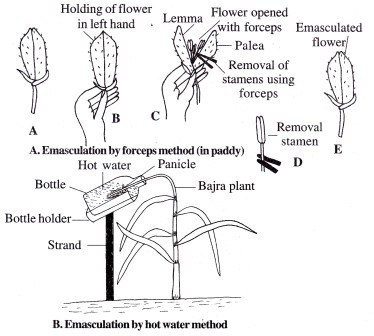
The removal of stamens from flowers of a female parent before the dehiscence of anthers is called emasculation. It is done a few hours before the opening of the flower buds. For panicle, one day before the opening of the first flower is selected for emasculation. Emasculation is performed to avoid self-pollination in the flower. It is always necessary for all bisexual flowers but is not required for unisexual flowers.
If flowers are large enough to do manual emasculation, the forceps or scissor method is adopted for emasculation. Eg, Paddy, wheat, cotton, etc. The base of flower is held between thumb and index finger of the left hand. With the right hand, the flower bud is opened using forceps and then stamens are pulled out with the forceps or scissors. This is tedious and painstaking work in hybridization.
In plants with very small-sized flowers, emasculation is done by using the hot water method. Eg. Sorghum, barley, etc. The panicle is kept dipped in hot water (45-53˚C) in a jug for 1-10 minutes. The hot water inactivates the stamen to avoid self-pollination.
In some crops, male sterility is introduced into plants either by back cross method or by treatment with 2, 4-D, or NAA or maleic hydroxide during the growth stage. Then the mare sterile plant is used as a female parent. Here, there is no need for emasculation. This method is often called male sterility method.
3. Bagging
After emasculation, the flowers or panicles are enclosed in a butter paper bag or muslin bag to protect them from contaminating pollen grains. This is called bagging. The size of bag is determined by the size of flower heads or panicle. Paper bags immersed in oil or wax protect flowers from insect attacks. In most cases, bagging is done in the evening. The bags are tied at the base using a thread or copper wire.
The male and female flowers are bagged separately to prevent the entry of pollen from outside. Bags are removed from the mare plants after collecting the pollen grains from the stamens. On the other hand, bags are retained on female flowers and panicles up to the stage of seed development.
4. Crossing
The transfer of pollen grains collected from male plants to emasculated female flowers is called crossing or artificial cross-pollination it involves the collection of pollen from desired male plants and putting them on the pistil of the emasculated flowers.
The pollen grains are collected from dehisced anthers of male flowers in a petridish or in paper bags. The stamens are gently teased with a forcep or brush to release the pollen from them. Then the released pollens are collected in a petridish.
The stigma of emasculated flowers is receptive in the morning hours so crossing is usually done in the morning. The bag is temporarily removed from the emasculated flower and the pollens are dusted on the stigma with the help of a hairbrush. After dusting the pollen, the female flower or panicles are covered with the bag to prevent the invasion of pollen from outside. This method is practiced in rice, wheat, cotton, maize, etc. In wheat, the entire anther is inserted into the emasculated floret using forceps. Here, there is no need to dust pollen on the pistil. If the flowers are too small as in sorghum, the male plant is grown near the female plant to facilitate cross-pollination.
5. Labelling
After transferring pollen grains, the flowers are properly tagged to the bag using a thread. A tag is a hard paper or light plastic sheet with desired shape. Labeling may be done on the bag or tag. The labeling must be brief but complete in the sense of-
- The number allotted to the field
- The number allotted to the plant in the field record
- Date and time of emasculation
- Date and time of crossing
- Details of male and female parents.
All other necessary information must be entered in the field notebook in time to avoid confusion at the later stages of the experiment.
6. Harvesting of Hybrid Seeds.
After reaching maturity, the bags are removed from the plant and the crossed heads or panicles are harvested from the plants.
Hybrid seeds are collected from the harvested heads, dried, and stored separately in polythene bags. These seeds are used to raise the next season’s crop.
7. Raising F1 Generation
The hybrid seeds obtained from the hybridization are sown separately in the field to raise F1 generation in the next season. All F1 plants are heterozygous but have similar genetic compositions. These plants are said to be a hybrid variety. They may or may not show hybrid vigour. If hybrid vigour is not recorded, the F1 plants are subjected to different hybridization methods to get subsequent improved generations.