
Phyllode theory
Modification of the petiole or any part of the rachis (axis of a compound leaf) into leaf-like flattened green structure is known as ‘phyllode’. The phyllode is the characteristic of xerophytic plants, and its main function is to carry on photosynthesis. The leaves of many plants which have to perform specialized functions become modified or metamorphosed into distinct forms. The phyllodes are common in monocotyledons, but rare in Dicotyledones.
The leaves of most monocotyledons are phyllodes instead of typical leaves in the true morphological sense. The leaves of those plants lack the lamina or blade. They so called apparent leaf blade comprises actually expanded petiole or leaf base or both. This replacement of leaf lamina by phyllode is not only confined to monocotyledons but also occurs rarely in dicotyledons, e.g. Acacia, Eryngium, Oreomyrrhis, etc. This view regarding the presence of phyllode in majority of the families of monocotyledons is supported by Arber (1920, 1925) and is known as Phyllode theory.
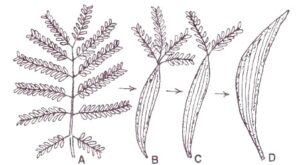
The peculiarity of possessing basal leaf sheath and a simple blade by numerous monocotyledonous families is a common feature. In dicotyledones, such petiole metamorphosed into expanded blade like structure. In Australian Acacia, The petiole or any part of the rachis becomes flattened or winged taking the shape of the leaf and turning green in colour . This flattened or winged petiole or rachis is known as phyllode.
In some species like, A. moniliformis, the normal bi-pinnate leaf develops in the seedling stage only, but soon falls off; later only the phyllodes develop throughout the life of the plant. In other species, as in A. melanoxylon, the mature plant bears both bipinnate leaves and phyllodes in its further development. In all cases, the leaflets fall off soon, and the phyllodes take over their functions, particularly the photosynthesis However, the edge of the phyllode is normally turned upwards, thus avoiding direct sunlight. This mechanism reduces the rate of transpiration i.e. excess loss of water. There are 300 species of Australian Acacia, all showing the phyllode. Some species of oxalis also develop phyllode particularly at their younger stage. Phyllodes found in monocotyledons may be either of petiolar or of leaf sheath in origin, the true lamina being absent or suppressed, so there are two types of phyllode-
- The petiolar phyllode and
- The leaf sheath phyllodel
Leaf-sheath and leaf base phyllodes also occur in many monocotyledons. In a leaf sheath phyllode, the leaf is further reduced. In petiolar phyllode the leaf represents two parts- the base and the petiole, the lamina is suppressed whereas, the leaf sheath phyllode consists of flattened base only. In several genera of Iridaceae and Liliaceae, the petiole is very small or reduced to minute apical portion, hence the leaf consists of flattened base only. In dicotyledonous genera, such corresponding leaf sheath phyllode with vestigial petiole occurs. The bud-scale of Fatsia japonica under the family Araliaceae is a typical leaf sheath phyllode. The leaf sheath phyllode is found in the monocotyledonous species Like Doryanthes, Distichia, Etegia, etc.
Significance of Phyllode theory:
1. Morphological support of this theory is given by the close resemblance of the monocotyledon leaf to the sheathing bases of some dicotyledon leaves.
2. The theory holds that the typical monocotyledon leaf arose by the self-adaptation of dicotyledon leaf.