Cucumber leaves are which type of venation?
Answer- cucumber leaves are reticulate venation. Leaves are simple, petiolate, palmately lobed, hairy and multicostate reticulate.
Types of plants leaves:
Plant leaves are two types. That are-
- Simple
- Compound
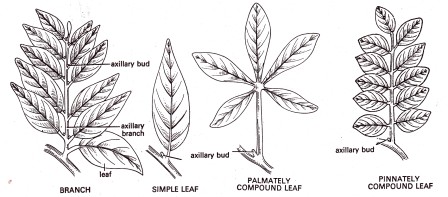
1. Simple. A leaf which maybe entire or incised to any depth, but not down to the midrib or petiole; e.g., Mango (Fig.1).
2. Compound: compound leaves divided into two types.
Palmately compound and
Pinnately compound
A leaf in which the leaf blade is incised up to the midrib or petiole, thus dividing it into two or more segments, called leaflets; e.g., Sweet pea, Gold mohur (Fig. 1).
(a) Palmately Compound: Palmately Compound leaves divided into five types.
A compound leaf with the leaflets attached at the tip of the petiole and thus seem to be radiating from a common point, like fingers from the palm; e.g., Cleome gynandra (Fig. 2). These are of five types.
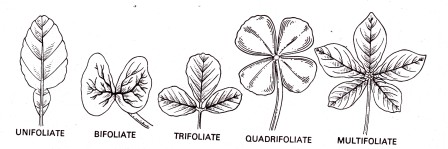
(i) Unifoliate. A single leaflet is articulated to the petiole; e.g., Citrus (Fig. 2).
(ii) Bifoliate. Two leaflets are articulated to the petiole; e.g., Hardwickia binnata, Prinsepia (Fig. 2).
(iii) Trifoliate. Three leaflets are articulated to the petiole; e.g., Medicago, Aegle, Oxalis (Fig.2)
(iv) Quadrifoliate. Four leaflets are articulated to the petiole; e.g., Paris quadrifolia, Marsilea (Fig. 2).
(v) Multifoliate (Digitate). Five or more leaflets are articulated to the petiole and spreading like fingers from the palm; e.g., Cleome (= Gynandropsis), Bombax (Fig. 2).
(b) Pinnately Compound: Pinnately Compound leaves divided into four types.
A compound leaf with the leaflets arranged along the sides of common axis, the rachis; e.g., Tamarind (Fig. 1& 3).
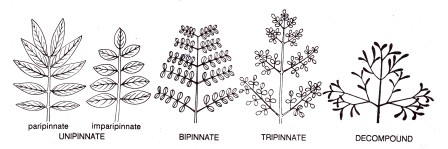
(i) Unipinnate. A pinnately compound leaf bearing the leaflets directly on the rachis; e.g., Cassia (Fig.13).
(A) Paripinnate. A unipinnate leaf with even number of leaflets e.g., Tamarind, Cassia sp. (Fig. 3).
(B) Imparipinnate. A unipinnate leaf with odd number of leaflets, e.g., Rose, Melia (Fig.3).
(ii) Bipinnate. A twice pinnate compound leaf i.e., the midrib produces secondary axes on – which the leaflets are borne; e.g., Acacia, Mimosa pudica (Fig. 3).
(iii) Tripinnate. A thrice pinnate compound leaf i.e., the secondary axes produce the tertiary axes which bear the leaflets; e.g., Moringa (Fig.3).
(iv) Decompound. A compound leaf which is more than thrice pinnate; e.g., Coriandrum (Fig.3).