
Guttation in plants:
Guttation in plants can be defined as the exudation of water droplets from the margin of leaves some plants such as garden nasturtium, tomato, Colocasia etc., watery drops ooze out from the uninjured margins of the leaves where the main vein ends. Guttation takes place usually early in the morning when the rate of water absorption and the root pressure are higher while the transpiration is very low. The watery drops consist of water in which inorganic and organic substances are dissolved. After the drops have dried the salts and organic substances etc., remain in the form of a residue on the margins of the leaves.
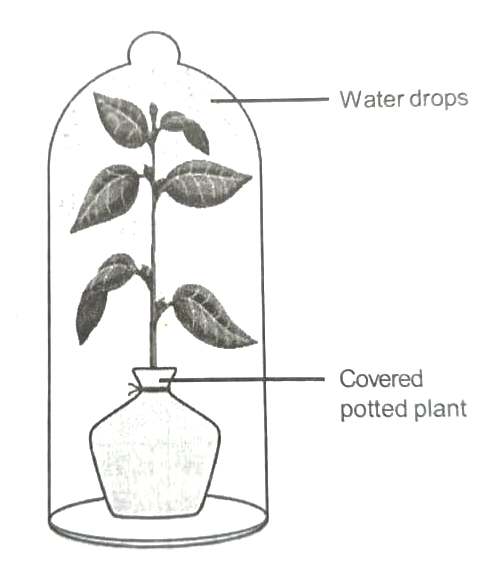
The phenomenon of guttation can be demonstrated by a simple experiment. A well-watered potted plant of garden nasturtium is kept under a bell-jar on a glass sheet. Before this, the pot is covered in a polythene bag to check the evaporation of water from the soil. The apparatus is made air-tight by applying Vaseline. The bell-jar is connected to an aspirator. Air is sucked from the bell-jar by means of the aspirator. After a very short time watery drops will appear on the margins of the leaves.
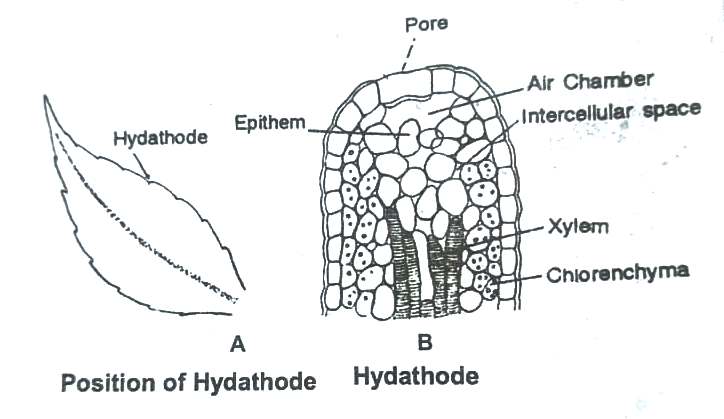
The phenomenon of guttation is associated with the presence of special types of stomata at the margins of the leaves which are called water stomata or hydathodes. Each hydathode consists of a water pore which remains permanently open. Below this, there is a small cavity followed by a loose issue called epithem. The epithem is in close association with the ends of the vascular elements of veins. Under higher root pressure the water is given to the epithem by the xylem of the veins. From epithem the water is released into the cavity. When this cavity is completely filled with the watery solution, the latter begins to ooze out in the form of watery drops through the water pore.
Differences between transpiration and Guttation:
| Transpiration | Guttation |
| 1. In transpiration, water is released in the form of water vapour from aerial parts of plants. | 1. In guttation, water droplets ooze out from the uninjured margins of aerial leaves. |
| 2. It occurs in all plants. | 2. It occurs only in some angiosperms such as garden nasturtium (Tropaeolum), Colocasia, tomato, etc. |
| 3. Transpiration occurs mostly through stomata; it may also take place through cuticle and lenticels. | 3. It occurs only through hydathodes (water stomata). |
| 4. Usually, it takes place throughout the day, with maximum rate at noon. | 4. Usually, it takes place early in the morning when root pressure and water absorption are higher. |