
Endocytosis
Definition:
Endocytosis is an energy-dependent process where cells engulf molecules such as proteins by invagination of the plasma membrane, forming vesicles that transport substances into the cell.
Most chemical substances important to the cells are large polar molecules that cannot pass through the hydrolpholic plasma membrane by passive means, hence these molecules can enter the cell by endocytosis. Endocytosis includes pinocytosis, phagocytosis and clathrin-mediated endocytosis or coated pit endocytosis.
Types of Endocytosis:
(a) Pinocytosis (cell drinking): The process of intake of fluid vesicles by living cells is called pinocytosis (Greek, pinenin to drink). Vigorous protoplasmic movement around the external fluid vesicle encircles and engulfs it. These vesicles are surrounded by membranes and become vacuole-like, initially present at the periphery of the cell and later on transported to the other portions of the cell or may fuse with other vesicles such as lysosomes.
(b) Phagocytosis (Cell eating): In this activity of plasma membrane, the solid materials having more than 0.75 µm in diameter are ingested and this process is called phagocytosis. This process serves as a mode of nutrition in most of the protozoans and also observed in some metazoans which is mostly meant to defend against foreign organisms.
(c) Clathrin-mediated endocytosis or coated pit endocytosis or Receptor-mediated endocytosis: The major route for endocytosis in most cells is that mediated by the well-addressed molecule ‘clathrin’. It is a large protein molecule that assist in the formation of a coated pit or the inner surface of the plasma membrane of the cell. This pit then buds into the cell to form a coated vesicle in the cytoplasm of the cell. By this process, it brings into the cell not only a small area of the surface of the membrane, but also a small volume of fluid from outside the cell.
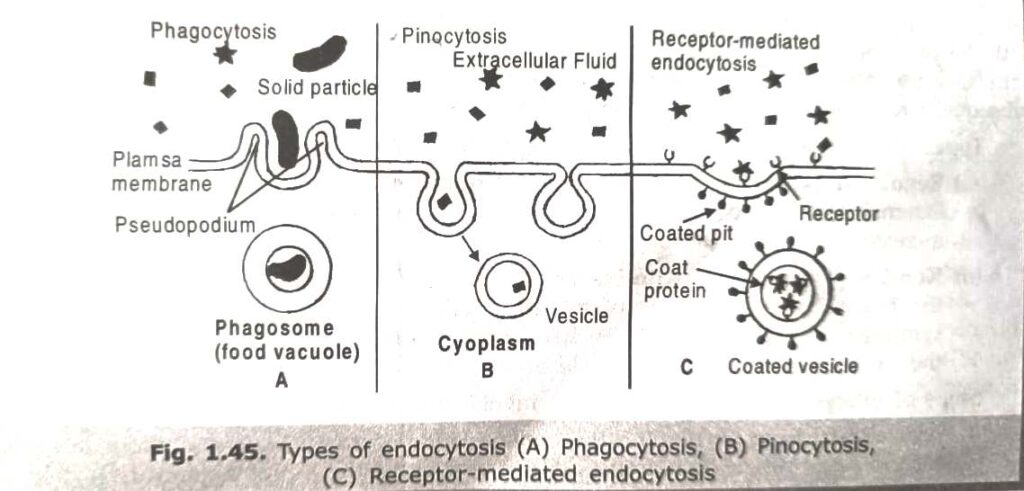
| Type | Description | Key Features | Examples |
| Pinocytosis (Cell drinking) | Uptake of extracellular fluid via vesicles, engulfed by vigorous cytoplasmic movement. | Vesicles become vacuole-like, may fuse with lysosomes | General fluid uptake |
| Phagocytosis (Cell eating) | Engulfment of solid particles larger than 0.75 µm, forming vacuoles for digestion. | Used in nutrition (protozoans) and defense (metazoans) | Amoeba engulfing prey |
| Clathrin-mediated endocytosis (Receptor-mediated) | Involves clathrin protein forming coated pits that bud into the cell as vesicles. | Selective uptake; important for LDL clearance | Most cells; LDL uptake |
Exocytosis:
Definition:
Exocytosis is an active process in which cells expel molecules (e.g., proteins) by fusing secretory vesicles with the plasma membrane, releasing contents into the extracellular space.
In exocytosis, secretory vesicles carry their contents across the cell membrane and into the extracellular space. These membrane-bound vesicles contain soluble proteins to be secreted to the extra-cellular environment. However, the mechanism of the secretion of intravesicular contents out of the cell is very different from that of the incorporation in the cell membrane of ion channels or signalling molecules
Types of Exocytosis:
(i) Regulated exocytosis or Ca² triggered non-constitutive exocytosis: It requires an external signal, a specific sorting signal on the vesicles, a clathrin coat as well as an increase in intracellular calcium.
(ii) Non-Ca triggered constitutive exocytosis: It is performed by all cells and serves the release of components of the extracellular matrix or just delivery of newly synthesized membrane proteins that are incorporated in the plasma membrane after the fusion of the transport vesicle.
| Type | Description | Trigger/Requirement | Function |
| Regulated exocytosis | Triggered by external signals; requires Ca²⁺ influx, clathrin coat, and sorting signals on vesicles | Requires increase in intracellular Ca²⁺ | Stimulus-dependent secretion |
| Constitutive exocytosis | Continuous secretion without external trigger; common to all cells | No Ca²⁺ trigger required | Delivery of membrane proteins, ECM components |
Steps of Exocytosis:
There are 5 steps involved in exocytosis.
1. Vesicle trafficking: It requires the transportation of a vesicle over a moderately small distance, eg vesicle that transport proteins from the Golgi apparatus to the cell surface area.
2. Vesicle tethering: Tethering involves links over distances of more than about half the diameter of a vesicle from a given membrane surface (25 nm). Tethering interactions are likely to be involved in concentrating synaptic vesicles at the synapse. Tathered vesicles are also involved in regular cell’s transcription processes.
3. Vesicle docking: Secretory vesicles transiently dock at the plasma membrane, preceding the formation of a tight / SNARE (protein) complex, leading to priming, and establishment of continuity between the opposite bilayers. SNARE proteins (soluble NSF attachment Receptor) are large proteins that mediate vesicle Fusion
4. Vesicle priming: Priming includes all of the molecular rearrangements and ATP-dependent protein and lipid modifications that take place after initial docking of a synaptic vesicle in neuronal exocytosis. In other cell types, whole secretion is constitutive (ie. continuous, non-Ca triggered), no priming is required.
5. Vesicle fusion: Transient vesicle fusion is driven by SNARE proteins, resulting in release of vesicle contents into the extracellular space or in case of neurons in the synaptic cleft.
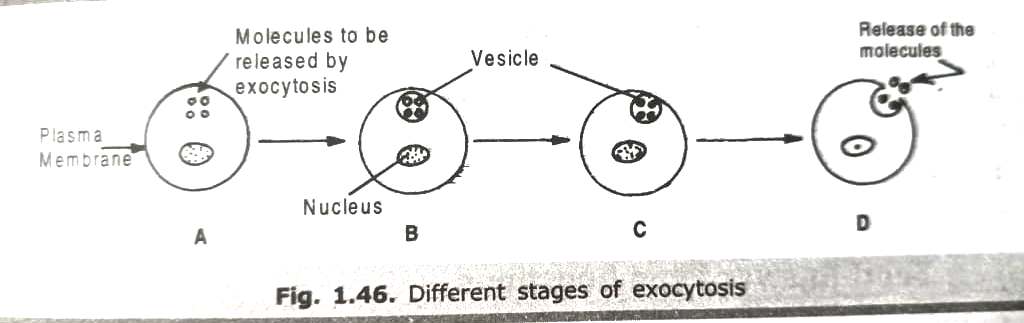
| Step | Description | Key Proteins/Processes |
| Vesicle trafficking | Movement of vesicles (e.g., from Golgi to plasma membrane) | Cytoskeletal transport mechanisms |
| Vesicle tethering | Vesicles linked near membrane surfaces (~25 nm) | Concentrates vesicles, prepares for docking |
| Vesicle docking | Vesicles transiently dock at plasma membrane, forming SNARE complexes | SNARE proteins mediate membrane interaction |
| Vesicle priming | Molecular rearrangements and ATP-dependent modifications preparing vesicles for fusion | ATP-dependent, especially in neurons |
| Vesicle fusion | SNARE-driven fusion, releasing vesicle contents extracellularly | Results in secretion or neurotransmitter release |
Terminology and Definitions:
| Term | Definition |
| Endocytosis | Active transport process bringing molecules into the cell via vesicle formation |
| Exocytosis | Active transport process expelling molecules from the cell via vesicle fusion |
| Pinocytosis | Endocytosis of extracellular fluid |
| Phagocytosis | Endocytosis of large solid particles |
| Clathrin | Protein forming coated pits in receptor-mediated endocytosis |
| SNARE proteins | Proteins mediating vesicle fusion with the plasma membrane during exocytosis |
| ATP | Energy currency required for vesicle trafficking, fusion, and associated molecular processes |